Register for the event
Endowus invites you to our exclusive event with Macquarie Asset Management, as we discuss unlocking opportunities in Infrastructure- a $1.3tn asset class.
This event is reserved for Accredited Investors (AIs) only. To register for the event, please indicate one of the following:
The original version of this article first appeared in The Business Times.
Every December, without fail, I have some version of the same conversation. A friend, a colleague, or a client of Endowus asks almost apologetically whether they have left it too late to top up their Supplementary Retirement Scheme (SRS) account for the year.
The answer is almost always no. Almost because everybody’s circumstances are different, and whether it is suitable is the key question. But for the vast majority it is not only a good idea, but a must. Yes, the window stays open until the banks' cut-off on Dec 31. But the question itself tells you something. For many of us, SRS is not a retirement strategy. It is a year-end admin chore and a tax-relief tool, filed somewhere between the Christmas shopping and the office dinner and dance.
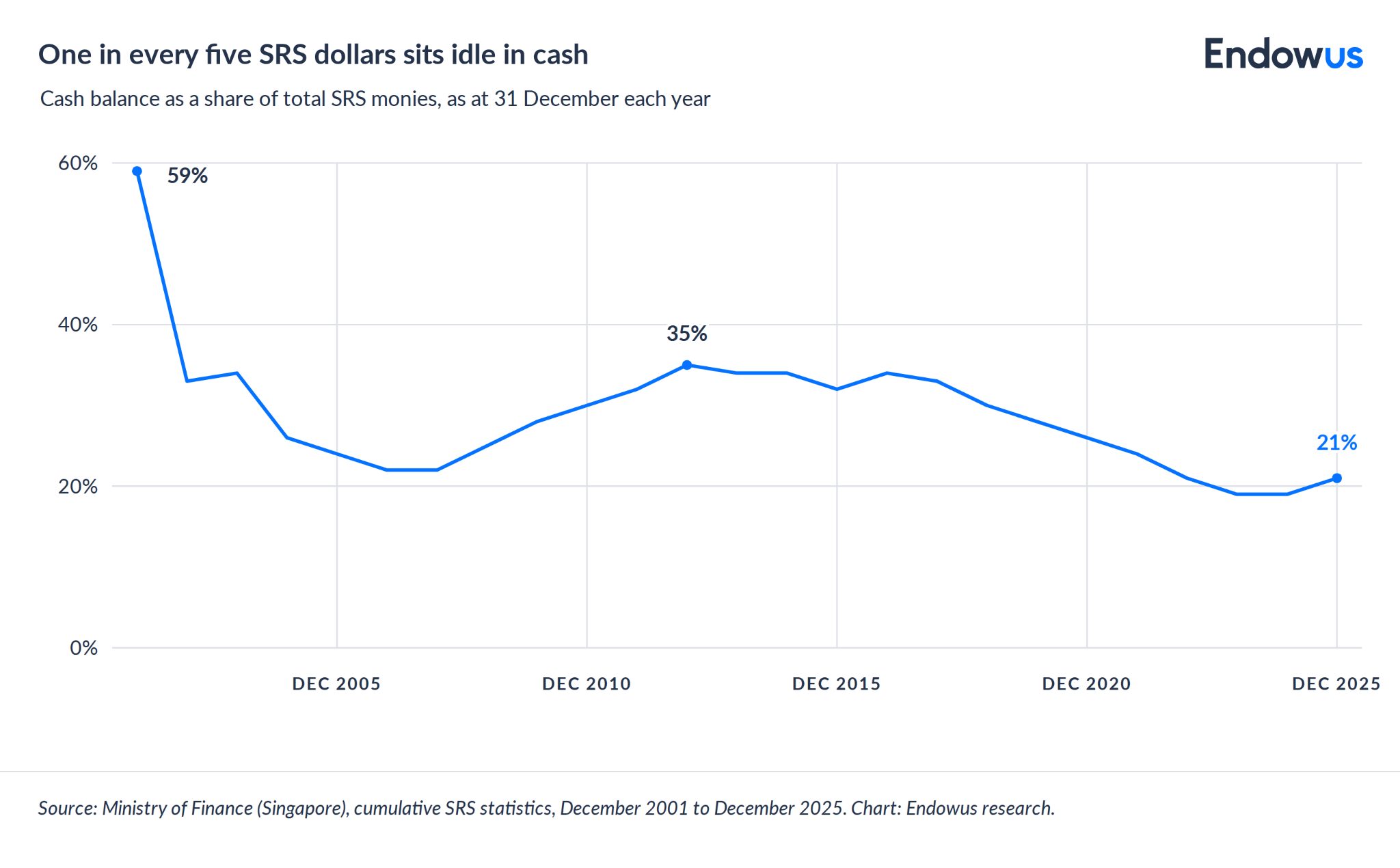
That would be harmless if the money then went to work. Often, it does not. At the end of 2025, about 21 per cent of all SRS monies sat in cash, according to the Ministry of Finance (MOF), up from 19 per cent a year earlier. Uninvested SRS cash “earns” 0.05 per cent a year, and that is before inflation. Across more than 516,000 account holders and nearly $24 billion of cumulative contributions, that is a great deal of retirement money waiting politely for instructions that never come.
It’s like a present left under the Christmas tree unopened, year after year.
Break the habits, don’t worry about the policy
Two well-documented biases are at work in this case.
The first is present bias. Harvard economist David Laibson showed in the late 1990s that we weigh today's costs and benefits far more heavily than tomorrow's, and Ted O'Donoghue and Matthew Rabin showed how this turns into procrastination right up to a deadline. SRS is almost a laboratory case. A contribution made on Dec 28 earns exactly the same tax relief as one made on Jan 2. However, it has spent eleven fewer months invested in the market. And that is the problem. Maybe we are focusing on the wrong thing. Whereas a tax break is a one time benefit for that year, the compounding effects of investing that money increases with time, so it does pay off to invest earlier.
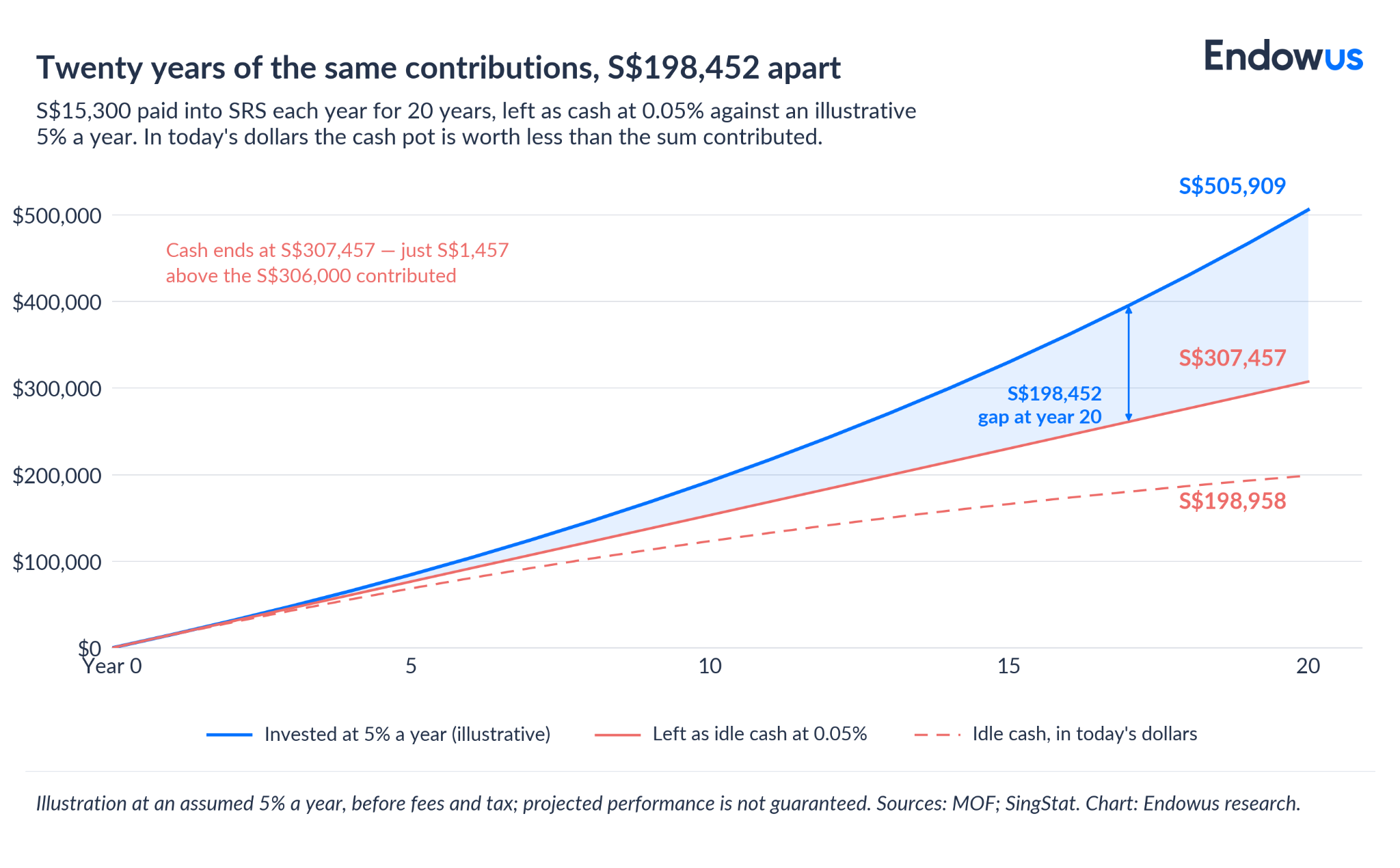
Even small differences compound. Take someone who puts in the full $15,300 a year for 20 years. At an illustrative 5 per cent annual return, contributing each January rather than each December leaves them roughly $25,000 better off at the end. No skill is involved, only time. Vanguard ran the same exercise for American savers who wait for the tax deadline to fund their retirement accounts, and gave it a fitting name: the procrastination penalty.
The second bias is less evident and more costly: inertia, reinforced by mental accounting. Nobel Laureate Richard Thaler's work shows that we sort money into mental buckets and treat each bucket differently. Many of us have filed SRS under "tax" rather than "retirement", and once the relief is banked, the job feels done. Brigitte Madrian and Dennis Shea's landmark 2001 study of US 401(k) plans showed how powerfully default behaviours stick: whatever happens when we do nothing is, for most people, what happens. In SRS, doing nothing means cash.
The same $15,300 a year, left in cash for 20 years, grows to about $307,000, barely more than what was put in. Invested at even an annual 5 per cent (and markets have been average double that in recent decade), it would be closer to $506,000. The tax relief gets banked. The compounding does not. For a scheme designed to supplement retirement income, that is a strange place for retirement money to settle.
Is it worth tweaking the way SRS is designed?
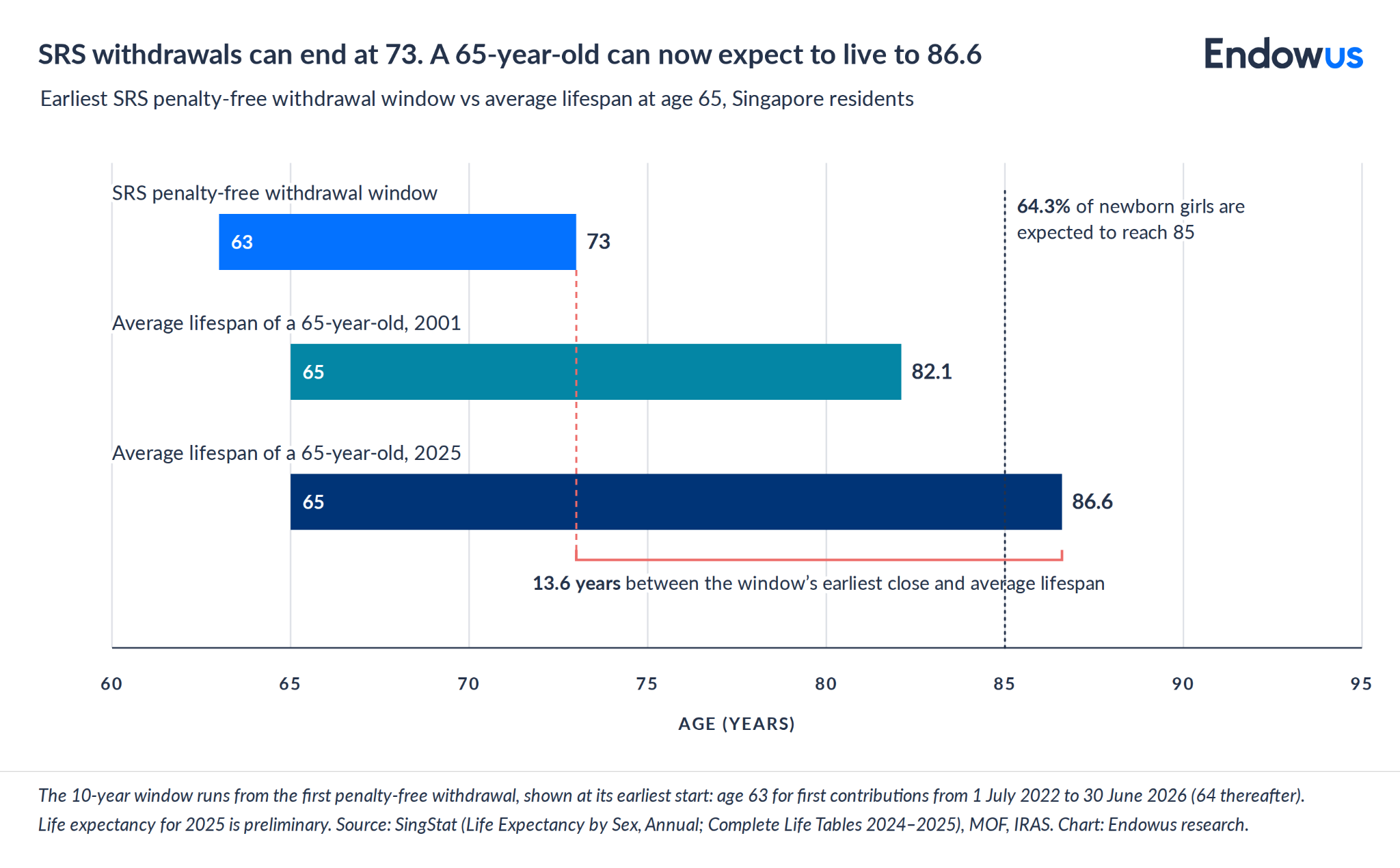
Some of this behaviour is habit, but some of it reflects how the scheme itself is built. SRS withdrawals follow a simple principle. From the statutory retirement age that applied at your first contribution, only half of what you withdraw is added to your taxable income. Members with no other taxable income can therefore withdraw up to $40,000 a year tax-free, or up to $400,000 over the ten-year withdrawal period that starts once drawdown begins.
That design made good sense when SRS was launched in 2001, and a ten-year window is still generous by many standards. But retirement has changed shape since then, as life expectancy has significantly increased. In 2001, a Singapore resident aged 65 could expect to live another 17.1 years. Today the figure is 21.6 years, according to the Department of Statistics, and nearly two in three girls born today are expected to reach 85. A ten-year drawdown that begins at 63 or 64 ends at 73 or 74, covering less than half of an average retirement and far less of a long one.
Any trusted financial advisor would say that a portfolio meant to last 25 years should be invested, and drawn down, very differently from one meant to last ten.
To be fair, SRS has already been refined several times. Contribution caps have risen, eligible investments have broadened considerably, life annuities are exempt from the ten-year rule, and MOF has committed to making withdrawals more convenient. Its own framing, made clear in a public reply in January, is that it reviews the scheme regularly, weighing demographic trends, retirement adequacy and fiscal sustainability.
That is the right approach. Separately, the new investment scheme for CPF members (previously known as LRIS or lifetime retirement investment scheme) announced at Budget 2026 shows that meaningful structural change is possible when the case for it builds.
The open question is one of timing: whether the ten-year window and the flat 50 per cent concession are due for the same kind of review that contribution limits and investment options have already been through.
One might also ask whether a retirement account should default to cash at all, rather than to a simple, diversified, age-appropriate option that members can opt out of. Marrying the SRS to the CPF investment scheme to make it a holistic lifetime glidepath could also make a lot of sense.
What investors can do while the rules stand
The more immediate problem is behavioural, and behavioural problems can be fixed today - there’s no need to wait for the scheme to change. In more than three decades of investing, I have found that the most valuable financial decisions are the dull ones, made early and then left alone.
First, contribute early rather than in the last week of December. If a lump sum in January is not practical, a monthly standing instruction does a great job, and takes both the decision and the deadline out of your hands. The reason is simple: potential to start compounding earlier.
Second, treat SRS as an investment account, not a tax savings account. Match what you hold to when you will need it. Money you will not touch for 15 or 20 years belongs in a globally diversified, low-cost portfolio. Money you will draw on in the next few years can sit in something more conservative than equities, but more productive than a 0.05 per cent nominal return.
Third, plan the withdrawal phase well before the statutory retirement age. When to begin, how to spread withdrawals to stay within the tax-free band, and how SRS sits alongside CPF LIFE payouts, CPF top-ups and your other savings are all decisions that interact, and they need to be considered holistically. Get them right together, and the tax concession will work as intended. Get them wrong, and you can pay tax you don't need, or run out of money before you run out of years.
This is where good financial advice creates true value. A trustworthy and competent fiduciary advisor that looks at your CPF, SRS and cash as one balance sheet rather than three separate products, works to minimise costs, and has nothing to gain from steering you to one solution over another can help turn a December ritual into a lifelong plan, with better outcomes.
From an annual ritual to a monthly plan
Tax relief is a nice reward for saving. Compounding is the much less talked about prize for putting it to work. The science of wealth has always said the second matters far more than the first.
So this December, by all means, make that last minute top-up before the tax year ends. However, your new year’s resolution should be to invest on a regular monthly cadence, not just your CPF but also your SRS to allow the power of long term compounding work in your favour.
Endowus CPF Portfolios outperform average returns of CPF Investment Scheme (CPFIS)-included funds in 2020

5 Things to know before investing your CPF

Webinar: Starting your CPF Millionaire journey early